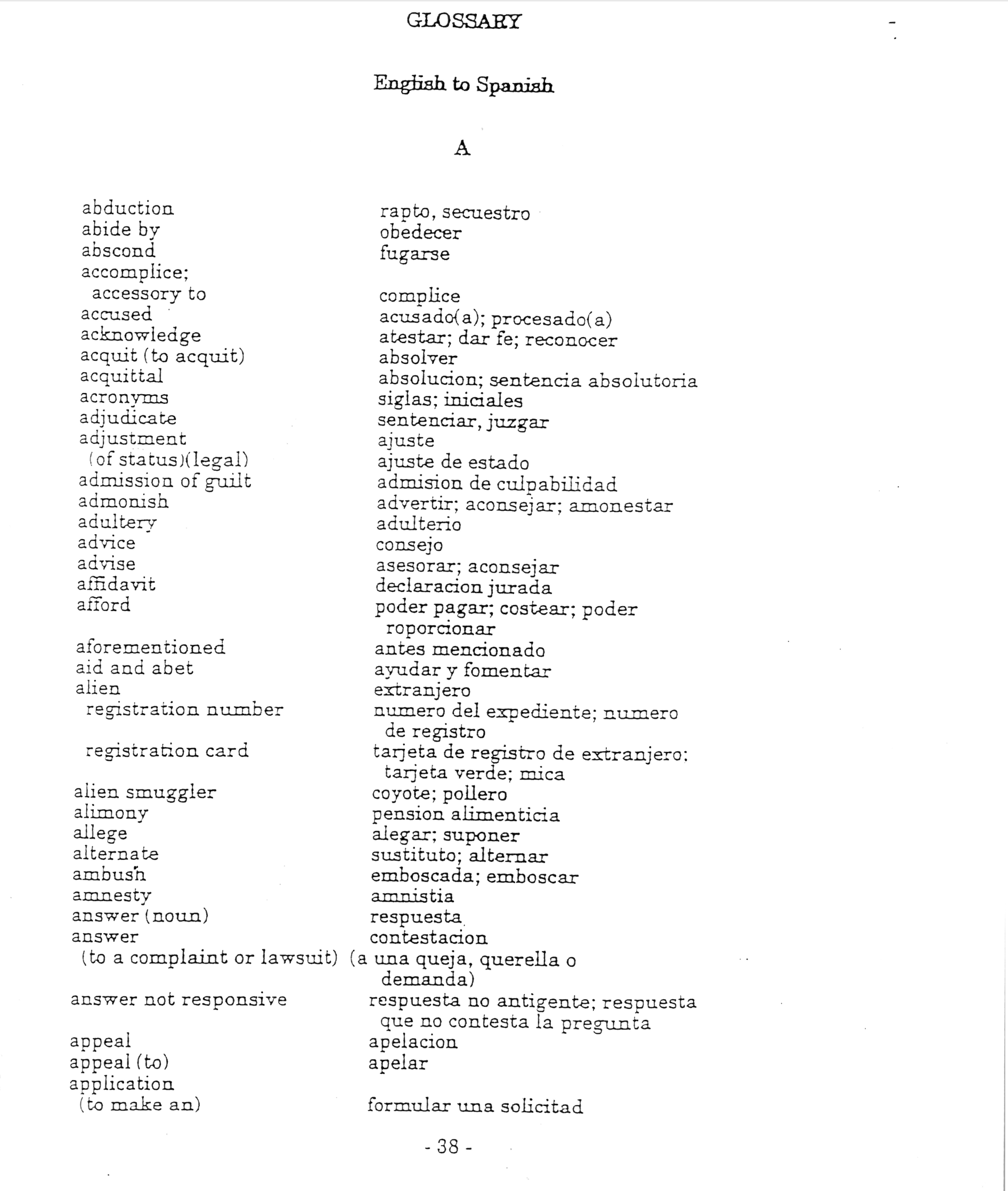
Berlitz English to Spanish
A bilingual glossary resource reflecting one strand of terminology support used in immigration-related contexts.
I once asked my sister, an Actual Linguist, what term I should use to refer to the people who do the kind of work I did at the time: translators, interpreters, terminologists focusing on managing the conceptual and terminological bases for trans-linguistic actions of many types (read: localization, internationalization, transcreation, all the -ns). Specifically, I asked her if "linguists" was OK as a "basket term". She shrugged; one of us suggested "field linguist", and while that might bring to mind people like the Summer Institute of Language, it felt close enough for me.
Here's the thing about field linguists, that we all know or should have reason to know about ourselves, but rarely admit in public:we think we're right.
The closest I've seen to a broad public admission of this was at a lunch table of Spanish language interpreters from all over the dialectical map; someone said, "Whenever there's a conversation about how to translate a specific term, there's always going to be someone who pipes up with'Pues en mí país se dice...' (Well, in my country, we say...)"; this was greeted with general laughter and agreement.
This is our Achilles' heel. Especially when interpreting, though it happens in translation as well: in the moment,you're the conduit. The job consists of making judgment calls, under pressure, under strain, under fatigue, balancing intuition and subconscious context with the conscious demands of the moment. And in that moment, that fraction of a time, under the best of circumstances, you make decisions. Or maybe you rely on your training and practice, especially with the fatigue. Or, worst case, 'whatever comes out is what comes out'que se te salga lo que se te salga.
I am, unabashedly, one of these drama queen field linguists. However, I have benefitted from the training and mentorship of many, and several in particular, practitioners who helped me understand why training, yes, but standardization and broad consensus around terminology management is the foundation not just of a skilled professional practice, but of an ethical and effective one.
In the moment, you are the decider. But in the context of your interlocutors, you are just one conduit amongst many. And if we, as a whole, are to be what we intend to be--conduits of meaning that neither add, nor subtract, nor omit, nor summarize meaning--then we must speak with one voice.
As another, deeply experienced, colleague once said in a moment of frustrated passion as a client insisted they spoke different dialects: "El español es uno y solo."***
There came a moment in my career wherein I was presented with a tremendous opportunity: the Executive Office for Immigration Review (Immigration Court) in Cleveland, Ohio, was hiring, for the first time, a staff interpreter. There are, of course, many full-time staff interpreters working in Spanish and a few other languages in Immigration Courts all over the United States; but we'd never had a full-time presence in Cleveland.
I was fortunate enough to be the first hire, quickly followed by wonderful, arguably more capable, colleagues. And I had learned from my mentors, one in particular, what I needed to do in this context: Build. Make the job bigger than me. Take a role and make it an institution. In the context of an interpretation department, there are always particularities according to the institution, but in many ways it begins and ends with terminology management.
I had a few glossaries about immigration terms; there was, at the time, an official EOIR glossary that was good, but several terms included in it referred to case law that was no longer applicable, which made me suspect it hadn't been revised in a while.
Me being me, I wrote an email to the head of Interpreter Services for the EOIR, and asked who was in charge of maintaining the glossary, explaining my interest and passion in the topic. The response was, of course, "That's amazing! It sounds like you're in charge of it!"
I did what I had been trained to do: get all the glossaries I could find, open a spreadsheet, and start researching.
I knew it was a substantial project. What I did not envision was that it would be a year and a half of sustained effort before I had something I could consider shareable, and that I would come to deeply understand the maxim: "A translation is never finished, merely abandoned."
I encountered the historical progression of US Immigration glossaries out of chronological order. However, presenting them in that order would bring this fully into the genre of memoir, which is not my intent. The following will attempt to reconstruct the history of these documents in the order in which they were created.
Immigration law in the United States is much younger than many are aware. I'll gloss over its earliest origins, unless more, older documents come to light. Our account begins, properly, in the era after the Second World War, when the conventions surrounding international asylum law were created. Countries that became signatories to those agreements necessarily incorporated those rules into the processes surrounding their sovereign territories. This included things like providing processes for those seeking asylum; it contemplated the possibility of managing cross-border flows of persons under circumstances of infectious pandemic, and moments of national emergency.
While thereis no official language of the United States, nor even an official language of law,(and, in subsequent decades, we put laws on the books that would prohibit, or at least complicate, such a declaration), thelanguage of record of the legal system of the United States is English.
But: Now we are considering contexts which specifically and explicitly invole extending that legal system to people who should not be assumed to speak English, or not speak it well enough to be linguistically present in legal proceedings. The US Governmment did not have the resources on-hand to figure out how to handle this. When it came to ensuring that those who didspoke with one voice, we, as humans, didn't even have a codified profession of "interpreter" yet. Consider the fact that the profession as such is considered to have been created during the Nuremberg Trials.
But don't worry, this is the United States. What do we do when we don't have the infrastructure to handle something? We contract the private sector to handle it.
So it was that Berlitz, experts in teaching language and writing tourism phrase books of all descriptions, found themselves writing glossaries for the first US border agents assigned to police the Mexico-US border.
A colleague, when he heard what I was working on, asked me for my address. I have no idea where he got these documents; no one in the EOIR that I asked knew of them. But true to his word, he sent me a manila envelope, previously used as inter-departmental mail from Kent State University, containing four documents produced by Berlitz.
The first three seemed to have been produced contemporaneously: a"Term List", an"English to Spanish Glossary", and a"Spanish to English Glossary". The last document seems to have been produced shortly afterwards, the"Supplementary List of Immigration Terms":"An additional list of terms that you may encounter in an immigration hearing."
Never finished, merely abandoned, indeed.
There is, it should be said, a lacuna in the record during the seventies and eighties. There may well have been official glossaries maintained during that time, and if you know of one, and even better if you have one, I'd love to see it.
At some point, probably in the nineties based on certain technological markers in the document, a new glossary was created. Once again, it was produced by a private concern; a well-known company that, for many years, was the primary contractor of field linguist services to the EOIR and, if I understand correctly, many branches of the US Government.
Unfortunately, someone in the Legal department of this concern was awake and paying attention, and there is a clear note in the footer of every page of the copy of this glossary that I have:"This glossary is the property of redacted.The copy or distribution of this document to other parties is strictly prohibited."
Hey -- I just received the document, no idea how. If I can determine that the document is, at this point, available elsewhere, I will link to it and discuss it more in depth. For the time being, however, I'll beg your forgiveness for not wanting to pick a fight with a company that has a much more well-funded legal department than I do.
Now we come back to where I came into the story. By the time I arrived at the EOIR en un momento del cual no quiero acordarme towards the end of the second decade of the 21st century, the EOIR had produced their own glossary. I've provided it here in the form in which I received it, in two parts, as"EOIR Glossary Part I"and"EOIR Glossary Part II".
Arguably the most relevant glossary of those I've seen to the actual work of the linguists working in that context, it included all kinds of terminological gold: official renditions of US federal agencies' names, gnarly case law references, and even country-specific sections that gave an interpreter drowning in the details of the Colombian civil war a lifeline to an adequate rendition.
Why is it in two parts? I'm not sure about that. It might have been all in one, but I scanned it wrong. Or, you know -- never finished, merely abandoned...
Back on track, picking up the story where I left it off:
I started with what I had available: the EOIR's glossary, the contractor-that-shall-not-be-named glossary, anda glossary that I had been trained on, briefly, a decade before by the very talented and capable Scott R. Loos.
I made a spreadsheet, and entered every term from each glossary, aligning them where there were duplicates, eliminating terms that were so long-forgotten or obsolete that they should not even be there (fewer than you would think, actually), and most vitally perhaps, beginning to collect terms, conflicts, explanations, and differentiations from our day-to-day work.
Then I got the Berlitz glossaries. Then I started looking at source materials: Official UNHCR documents translated into multiple languages. My master spreadsheet of comparative glossaries went from a cool research assignment to the stuff of nightmares, red yarn and pushpins on a bulletin board.
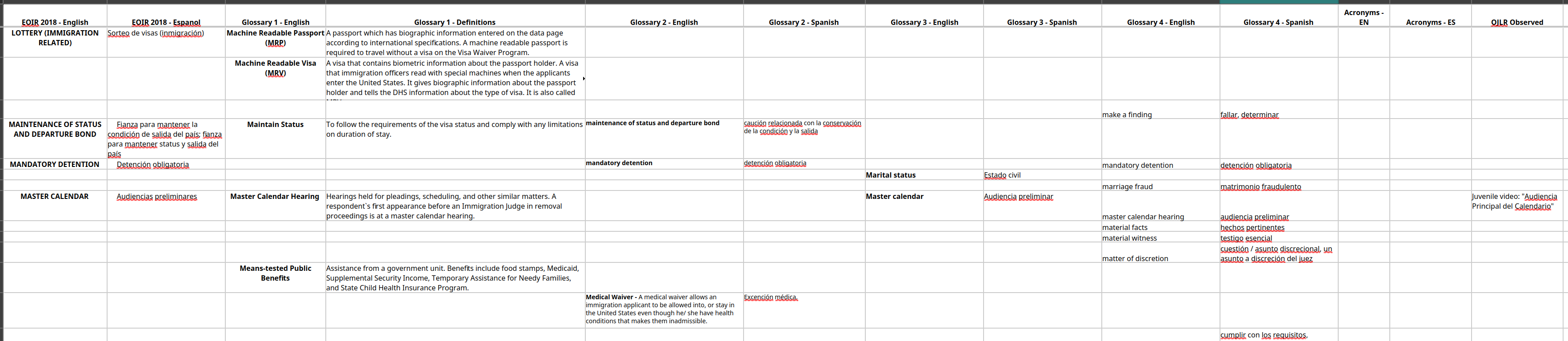
At the time, I did not have the technical skill to create the kind of metadata-enabled backend that the project needed, so I settled on an in-between solution of a spreadsheet with a "Master Terms List" tab, and then "breakout", topic-specific tabs for the domain-specific cul-de-sacs that kept us up at night: "Decisions and Appeals"; "Sex Crimes"; "Grounds and Standards of Proof"; "Nationality and Status"; "Comparative Hierarchical Denominations of Territorial Organization in Central America" (ok that last one I never got around to, but it's arguably the single most difficult one that comes up in almost every damn hearing).
Those tabs are reflected in this version of the glossary through theCategories that you can see on the home page.
So: For the Record, here is the original dedication I included in the version of the glossary that I, finally, shared to the rest of the EOIR, redacted only to protect the names of the innocent. Scott Loos, as well, is innocent, but is also a named author of one of these resources: I include his name in recognition of what he has done for our profession, and for me.
This glossary was composed by Staff Interpreters Oliver Renwick,redacted, and redacted of Cleveland EOIR. Of inestimable assistance were the consultative opinions, offered happily and frequently, of Immigration Judgeredacted and Attorney Advisorredacted. Scott Loos provided my initial basis in Immigration terminology and invaluable training in terminology research, and redacted andredacted provided some excellent historical and explanatory terminology bases. Other EOIR interpreters made additional contributions, which I endeavoured to note in the text, and I am sure I am forgetting others who helped explain key concepts to me.
The intention of this glossary is not prescriptive or restrictive; rather, it seeks to serve as a reference and a starting point for further development and elucidation of the twisted terminological webs of this field of law, administration, and procedure. More than anything else, as I drafted the explanations, I thought of the interpreter who has been newly hired to the EOIR, and can't make heads or tails of what the difference is between an admission and a concession, or why people aren't following the Federal Rules of Evidence.
In composing this glossary, I began by compiling every term from every official and otherwise reputable Immigration glossary I could find--seven or eight in total--cross-referenced all of them for consensus on terms, and began researching, revising, and occasionally deleting.
I hope this glossary is the next step in what is already a long history of terminology study and standardization in the immigration agencies of the United States. -Oliver JL Renwick
*Unfortunately, there is a very significant chunk of this history which, at least for the time being, does not appear to be publicly disseminable. See 'The muddy bit in the middle' for more.
**According to the best attempts and efforts of Oliver Renwick and colleagues; any successes are to be credited broadly, and all failures specifically on Oliver.
***Untranslatable. -Trans.
A bilingual glossary resource reflecting one strand of terminology support used in immigration-related contexts.
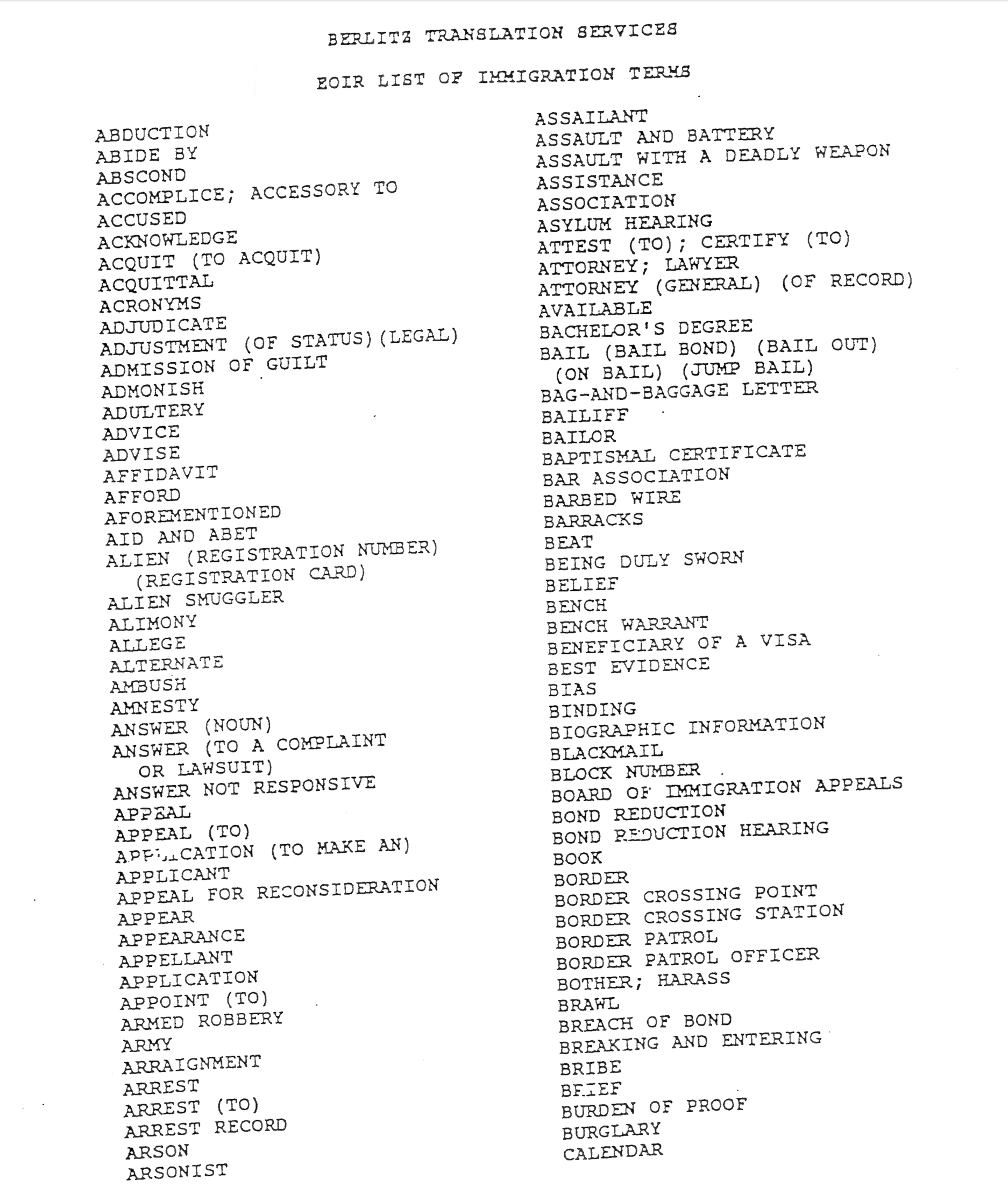
A term list associated with Berlitz immigration-court glossary materials.
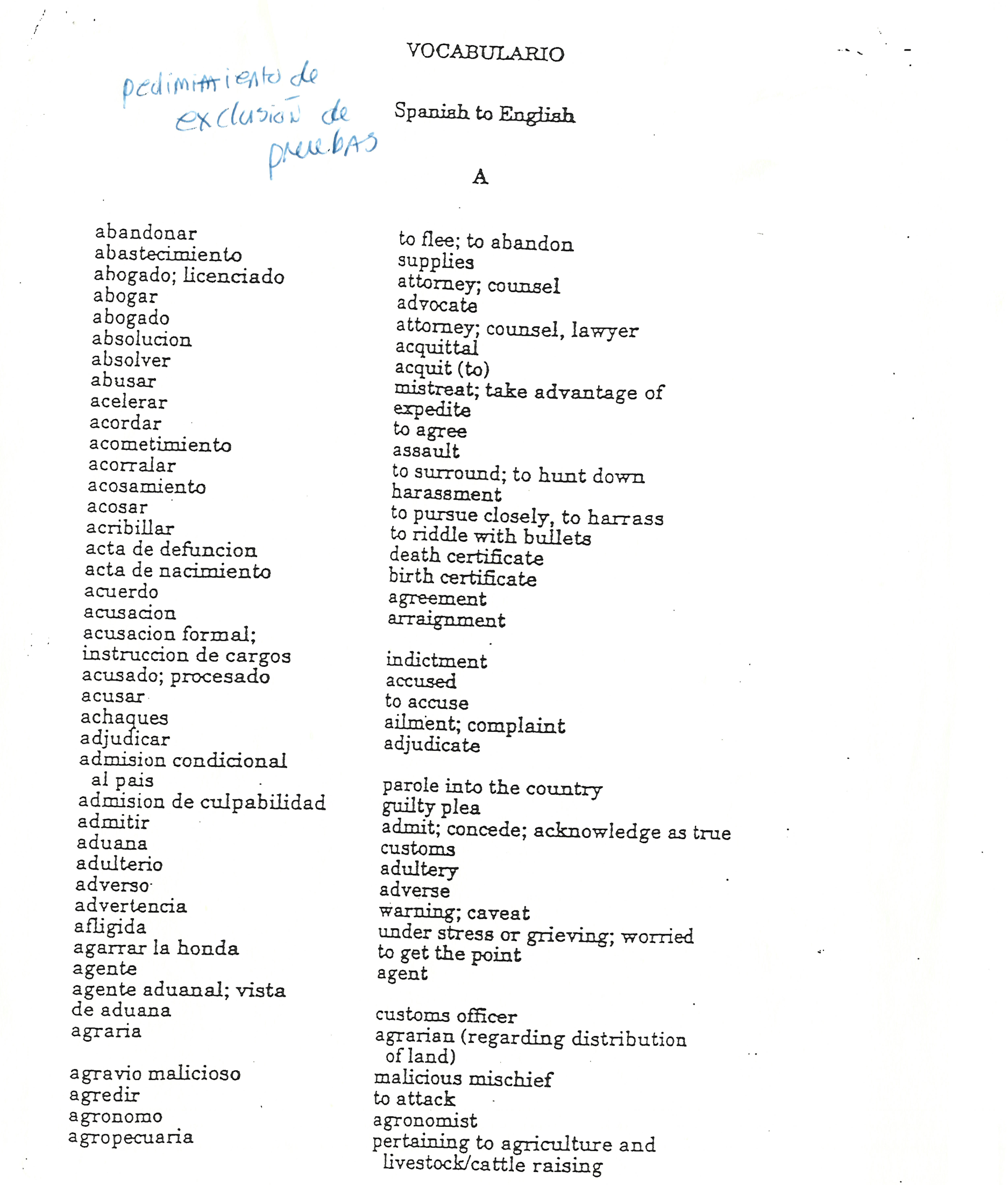
A reverse-direction bilingual glossary showing Spanish-to-English legal and court terminology.
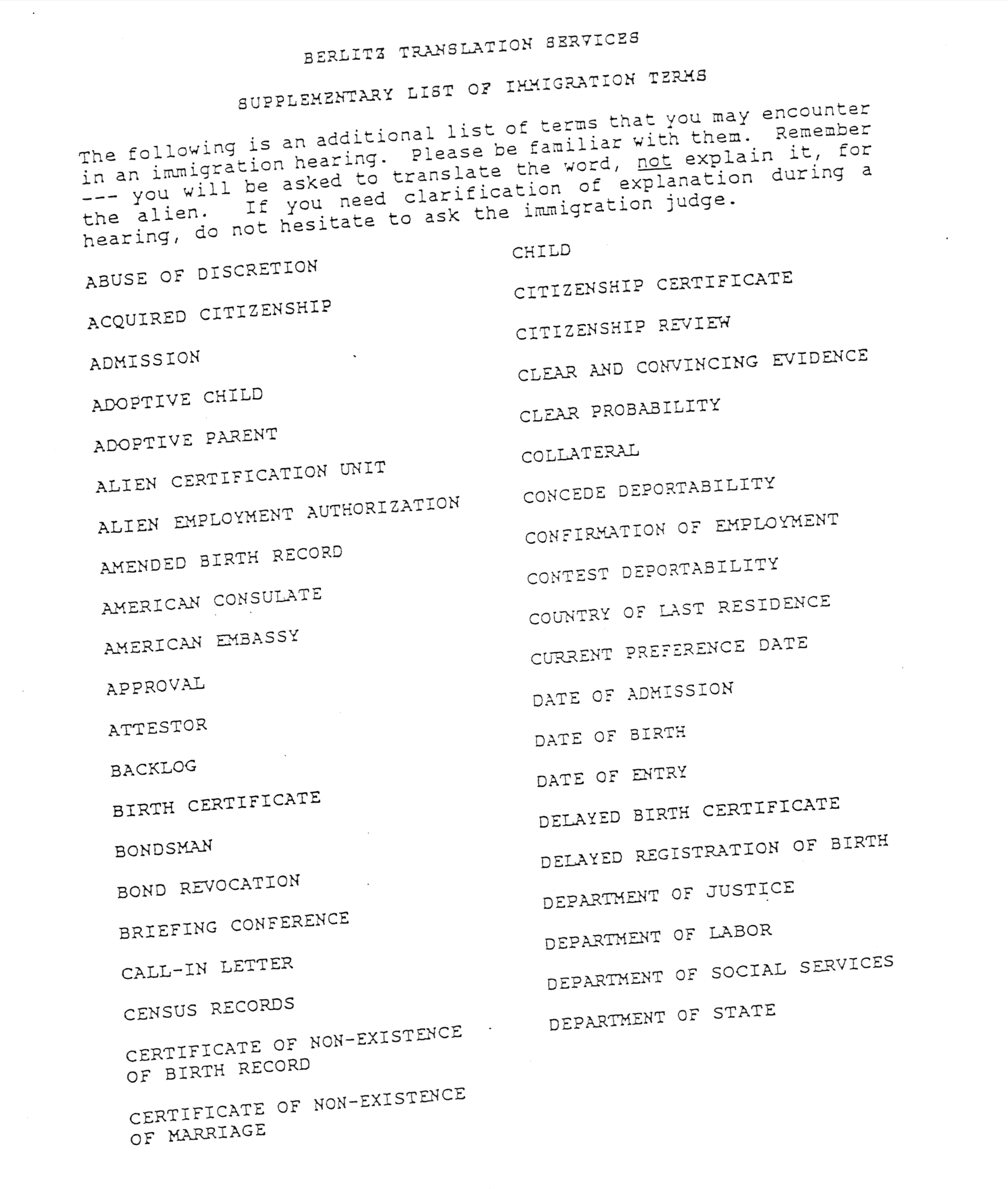
A supplementary term list illustrating how glossary work often expanded through addenda and practical updates.
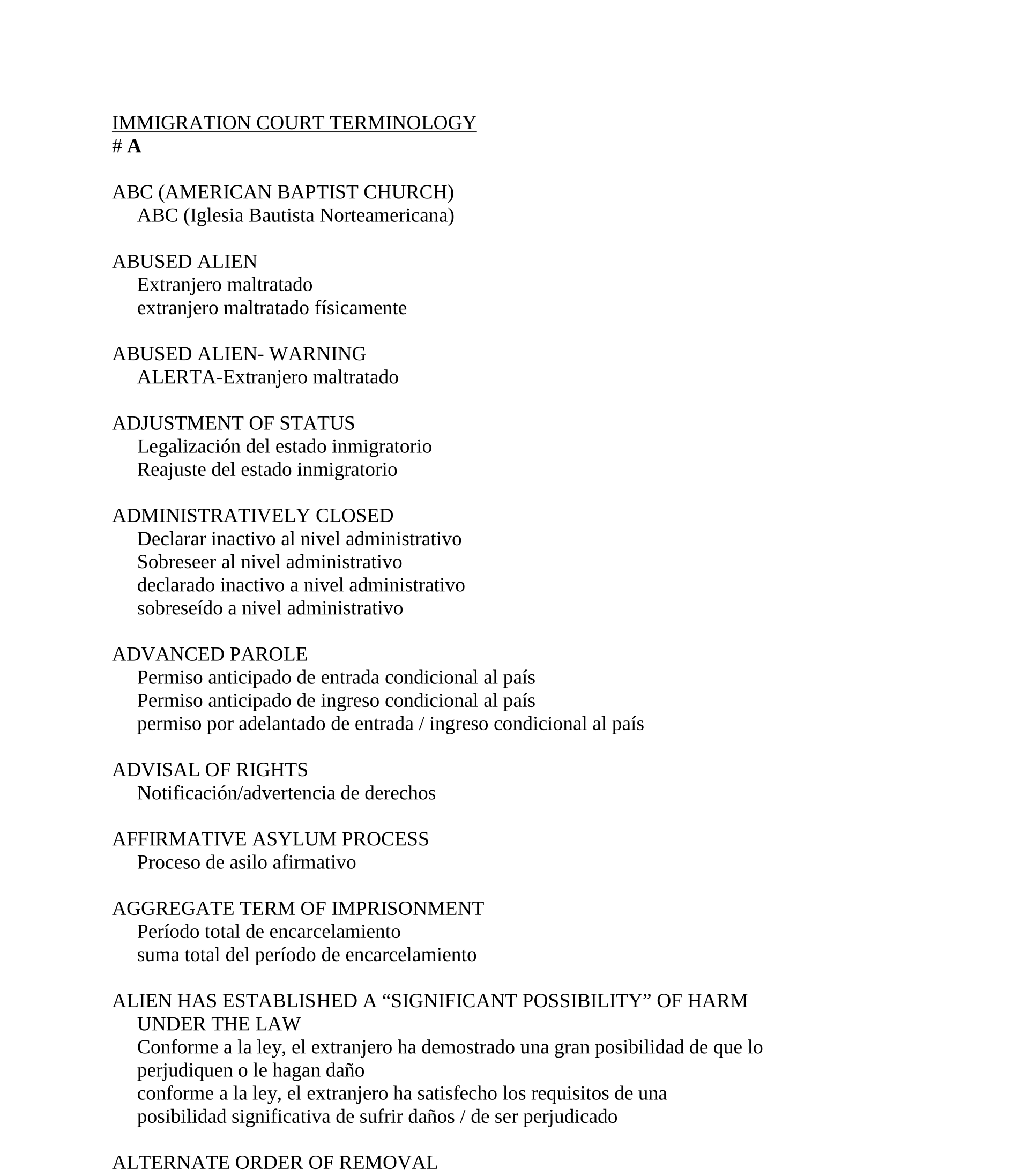
Part one of an EOIR glossary document reflecting institutional terminology work in immigration court settings.
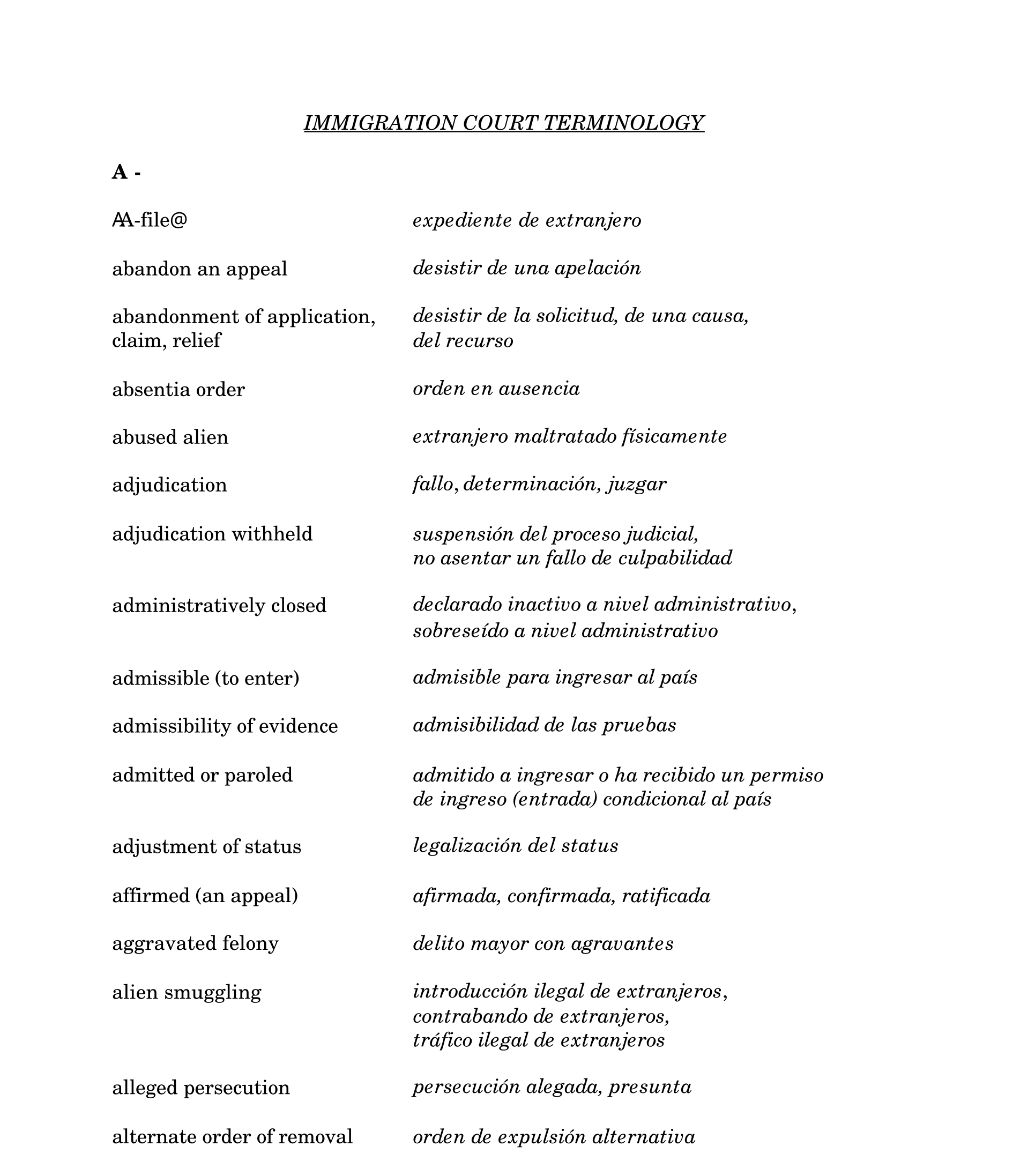
Part two of an EOIR glossary document, continuing the terminological record and institutional framing.

An immigration glossary associated with earlier terminology practice and reference work.
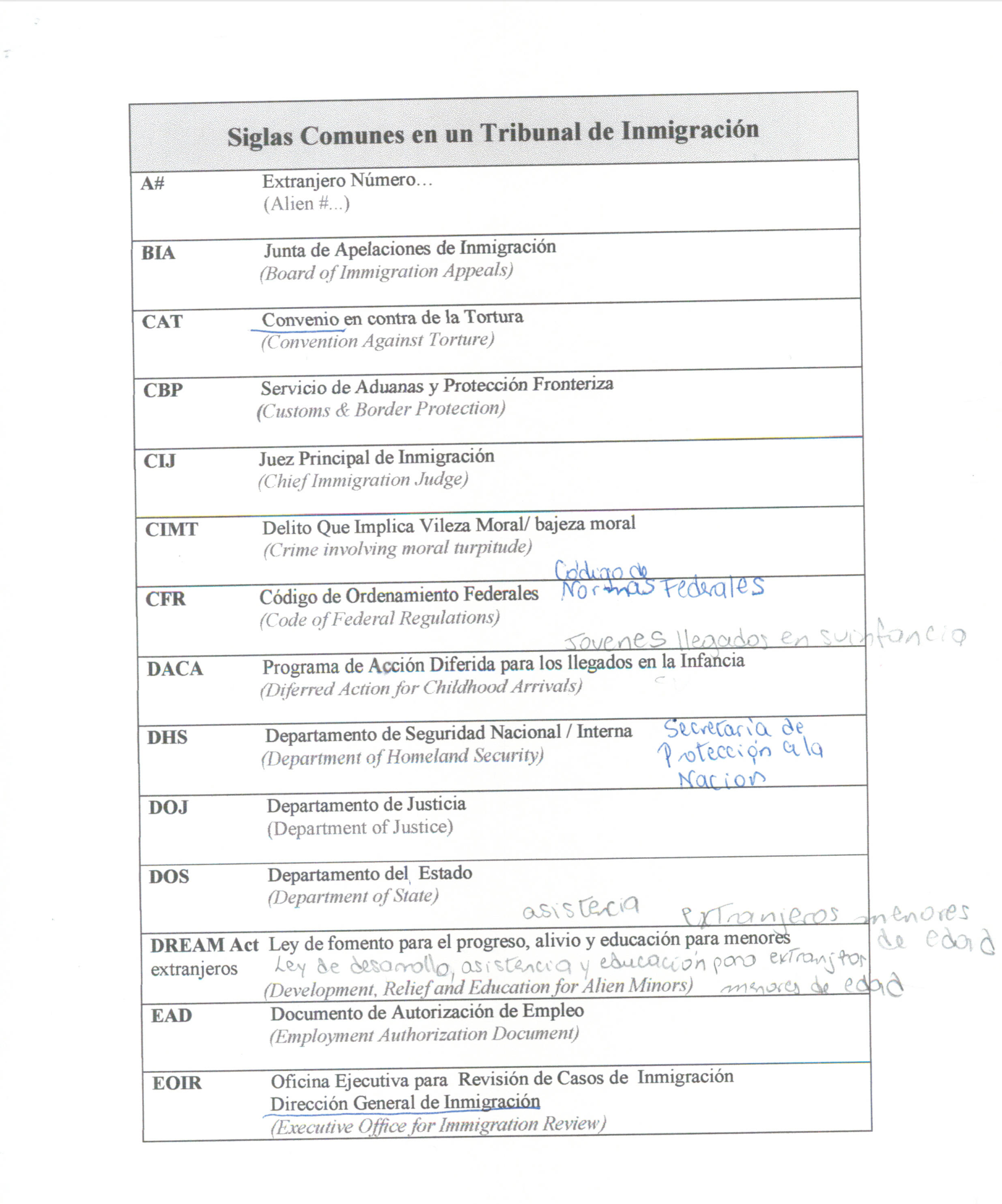
A reference for common acronyms used in immigration-court contexts.
| Title | Author |
|---|---|
| Anuario de la Comisión de Derecho Internacional 2009, Vol.I | — |
| Aplicación del estándar de prueba por los jueces promiscuos | Varios |
| BIA Interim Decision 3342, In re C-V-T-, Respondent | — |
| Black's Law Dictionary, 9th Edition | — |
| Codigo de Procedimiento Penal de Peru | — |
| Convención contra delincuencia organizada y trata de personas | Naciones Unidas, Oficina contra la Droga y el Delito |
| Convención internacional sobre la protección de los derechos de todos los trabajadores migratorios y de sus familias | Naciones Unidas |
| De los Motivos Fundados | Zuluaga |
| Diccionario de Ossorio | Manuel Ossorio |
| Diccionario Juridico Universal Paraguay | — |
| Directiva 2001-55-CE del Consejo de 20 de julio de 2001 | Varios |
| EASO Practical Guide: Evidence Assessment | EASO (European Asylum Support Office) |
| Estándares probatorios en el sistema acusatorio y su desarrollo en Colombia | Claudia Edith Velandia Coy |
| Garner, Bryan A. A Dictionary of Modern Legal Usage, Second Edition. New York, New York: Oxford University Press. | — |
| Glosario de Términos y de Conceptos Jurídicos o Relativos al Poder Judicial | Oficina de Administración de los Tribunales, Academia Judicial Puertorriqueña, 2015 |
| Guía Práctica de la EASO: Valoración de las pruebas | EASO (European Asylum Support Office) |
| Guia practica para responsables de expedientes relativos al convenio de cobro de alimentos para los hijos de 2007 | — |
| Handbook on Procedures and Criteria for Determining Refugee Status and Guidelines on International Protection | UNHCR |
| http://noticias.juridicas.com/base_datos/Admin/rd2393-2004.t11.html#a138 | — |
| https://2009-2017.state.gov//documents/organization/65466.pdf | — |
| https://foreignpolicy.com/2015/01/26/al-qaeda-islamic-state-myth-of-the-terrorist-safe-haven/ | — |
| https://www.law.cornell.edu/wex/es/leyes_predominantes_que_afectan_la_inmigraci%C3%B3n_y_naturalizaci%C3%B3n | — |
| I-877 | DHS |
| Immigration and Nationality Act | Various |
| Informe Final, El estándar de prueba en los proceso administrativos sancionatorios | Lucero Ocampo Henao, Johana Catalina Restrepo Ramírez, Dr. Luis Orlando Toro Garzón |
| La Legitimación en el Código Civil y en la Ley 14.367 | Guillermo F. Frugoni Rey |
| Léxico Temático de Terminología Jurídica Español-Inglés | Rebecca Jowers |
| Ley de Migración, publicada en el Diario Oficial de la Federación el 25 de mayo de 2011 | Cámara de Diputados del H. Congreso de la Unión (de México) |
| Lobo, S., 1992. A House Of My Own. Tucson, Ariz.: University of Arizona Press | — |
| Los estándares de prueba en el proceso penal español | Jordi Ferrer Beltrán |
| Manual Sobre Procedimientos y Criterios para Determinar la Condición de Refugiado y Directrices sobre Protección Internacional | ACNUR |
| Nuevo Código de Proceso Penal de Perú | Ministerio de Justicia y Derechos Humanos |
| Precedente Judicial | Victoria Iturralde |
| Public Law 104-208, Sept. 30 1996 | Various |
| Public Law 105-100, Nov. 19, 1997 | Various |
| Publication 850 (EN-SP) | IRS |
| Reglamento de pasaportes y del documento de identidad y viaje, publicado en el Diario Oficial de la Federación el 5 de agosto del 2011 | Varios |
| Reglas de Evidencia de Puerto Rico | Tribunal Supremo de Puerto Rico |
| Reglas de Procedimiento y Prueba | Corte Penal Internacional |
| Sentencia Casación No. 1640-2019-Nacional | Corte Suprema de Justicia de la República (de Perú) |
| STS 1257-2020-ECLI: ES:TS:2020:1257 | Tribunal Supremo de España |
| Style Manual | GPO, 2016 |
| Taller de Litigación Oral Básico | Fernando Ugaz Z. |
| Terrorist Safe Havens | US Dept. of State |
| The Inconvenience of the reasonable person standard in criminal law | Juan Pablo Pérez-León Acevedo |
| The Operation of the Immigrant Numerical Control System | US Dept. of State |